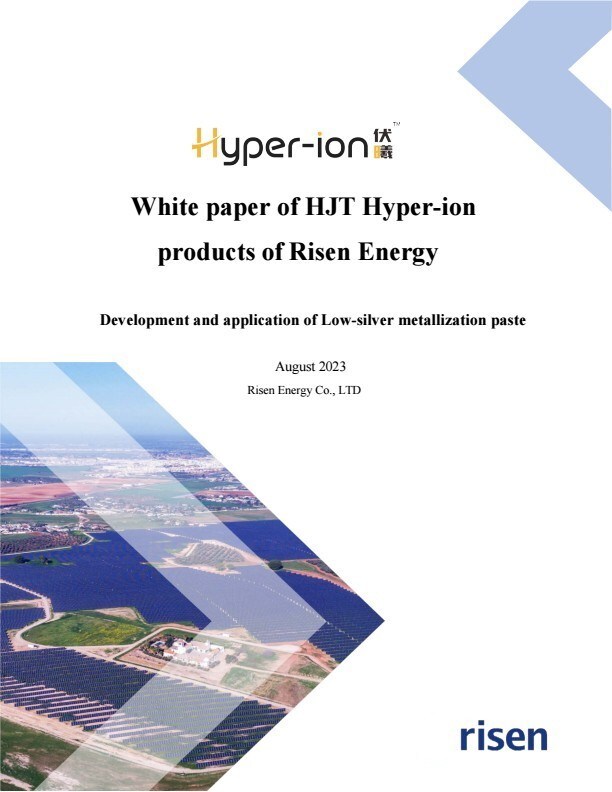
, /PRNewswire/ — Recent discussions within the photovoltaic industry have intensified around reducing silver paste costs and developing innovative metallization materials. In this context, we revisit Risen Energy’s technical white paper—White Paper of HJT Hyper-ion Products: Development and Application of Low-Silver Metallization Paste—to reexamine the company’s early strategic insights, experimental validations, and foundational preparations. This retrospective analysis aims to provide industry peers with practical perspectives derived from hands-on experience.

I. Foresight and Systematic Planning: Beyond Mere Substitution
Confronting silver’s limited reserves and price volatility, Risen Energy recognized that adopting low-cost metal alternatives was imperative for sustainable growth—akin to the historical transition from gold to copper interconnects in integrated circuits. The company’s approach extended beyond conceptual substitution to systematic implementation:
Comprehensive Material Selection: Risen Energy evaluated candidate metals (e.g., copper, aluminum, zinc, nickel) based on three criteria: electrical conductivity, global reserves, and market stability. Copper emerged as a prime candidate due to its high conductivity (5.96×10⁷ S/m), ample reserves, and cost-effectiveness.
Strategic Technology Pathway: While electroplating offers a silver-free alternative, Risen Energy prioritized low-silver-content paste—where a silver shell encapsulates low-cost metal cores—for its compatibility with existing production lines and rapid scalability.
Rigorous Reliability Validation: The white paper shows that modules employing low-silver-content pastes demonstrate excellent degradation rate performance after undergoing damp heat (DH) and thermal cycling (TC) tests with severity levels multiplied by several times. In some cases, their performance even surpasses that of modules using pure silver pastes, and their power generation capacity is comparable to that of pure silver paste modules.
II. From Innovation to Industrialization: Leadership in Mass Production
Risen Energy’s HJT products have achieved stable, large-scale mass production on production lines for multiple years. Currently, the pure silver consumption of Risen Energy’s HJT cells has been reduced to 3.9 milligrams per watt (mg/W), a level that is at the forefront globally.
III. Reflections and Future Outlook: Value-Driven Progress
This review highlights three core principles underpinning Risen Energy’s strategy:
Inherent Synergy Between HJT and Low-Silver Materials: HJT’s low-temperature manufacturing, bifaciality, and superior passivation provide an ideal platform for safe, efficient metallization innovation.
Cost Reduction as a Value Multiplier: By integrating material optimization with process excellence, Risen Energy ensures lower LCOE and higher ROI without compromising reliability or power output.
Material Innovation as an Industry Catalyst: Silver reduction transcends cost savings, representing a paradigm shift in photovoltaic technology and sustainability.
Thank you to all customers and partners for your continuous attention to and trust in Risen Energy’s HJT technology. Risen Energy will continue to uphold the original aspiration of “cost reduction and efficiency improvement”, promote the industrialization process of HJT technology, and contribute solid strength to the global energy transition.